Stryker Wiper Attack — Iran-Linked Handala Group Weaponizes Microsoft Intune to Mass-Wipe 200,000+ Devices Across 79 Countries
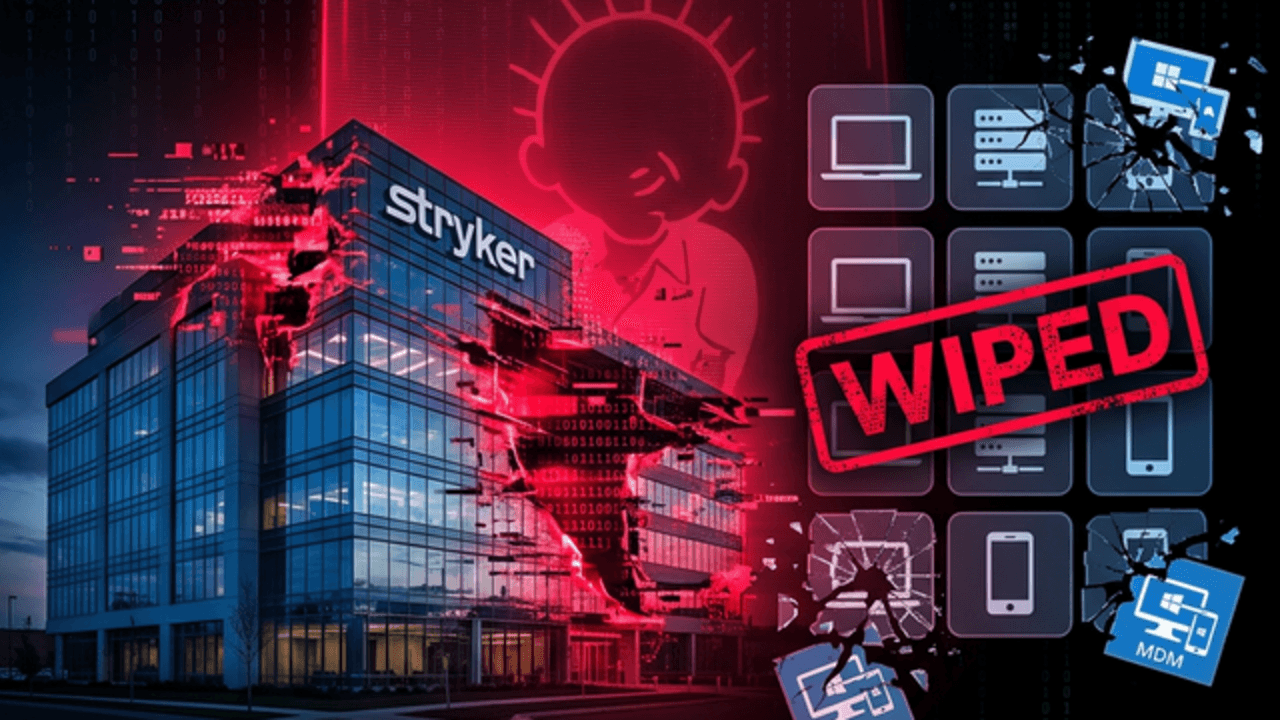
Iran-linked hacktivist group Handala (Void Manticore / Storm-0842) claimed responsibility for a devastating wiper attack on medical technology giant Stryker Corporation. The attackers weaponized Microsoft Intune's legitimate remote wipe capability to factory-reset over 200,000 devices — servers, laptops, and mobile phones — across 79 countries, while claiming to exfiltrate 50 TB of data. No traditional malware was used. The attack represents a paradigm shift in destructive operations: identity compromise as a weapon of mass disruption.
On March 11, 2026 at approximately 3:30 AM EST, employees at Stryker Corporation — a $23 billion medical technology giant supplying surgical equipment, implants, and hospital infrastructure to healthcare systems in over 100 countries — discovered their devices had been wiped. Laptops showed factory-reset screens. Servers were offline. Mobile phones were bricked. Login pages across the organization displayed a single image: the Handala logo.
The Iran-linked hacktivist group Handala (also tracked as Void Manticore, Storm-0842, and COBALT MYSTIQUE) claimed responsibility within hours, asserting it had wiped over 200,000 devices across 79 countries and exfiltrated 50 terabytes of critical data — all in retaliation for a missile strike that hit an Iranian school on February 28, 2026.
Stryker filed an SEC 8-K (Item 1.05) the same day, confirming a severe global disruption to its Microsoft environment. The company reported no indication of ransomware or traditional malware. That detail is the most important one in this entire incident — because it reveals that the attackers didn't need malware at all.
They used Stryker's own tools against it.
The Attack: Microsoft Intune as a Weapon
The Stryker incident represents a paradigm shift in wiper operations. Previous Iranian wipers — Shamoon, ZeroCleare, Hatef, BiBi — relied on deploying destructive malware to disk. This attack used none.
Instead, Handala compromised administrative credentials for Microsoft Intune, Stryker's cloud-based Mobile Device Management (MDM) platform. With Intune admin access, the attackers issued legitimate remote wipe commands to every enrolled device — the same commands an IT administrator would use to factory-reset a lost laptop or decommission a phone.
The result was identical to a wiper attack, but executed entirely through trusted infrastructure. No payloads to detect. No suspicious binaries to flag. No endpoint protection alerts to trigger.
This is living-off-the-land at its most devastating — weaponizing the management plane itself.
Full Attack Timeline
| Timestamp | Event |
|---|---|
| Late February 2026 | Handala likely begins initial access — credential harvesting via phishing or exploitation of exposed services (VPN gateways, web-facing applications) |
| Early March 2026 | Privilege escalation and lateral movement within Stryker's Microsoft / Entra ID environment. Attackers gain Global or Intune Administrator privileges |
| Pre-March 11 | Data exfiltration begins — Handala claims 50 TB staged and extracted before the wipe |
| March 11, ~3:30 AM EST | Mass remote wipe commands issued via Microsoft Intune to enrolled devices worldwide |
| March 11, Morning | Employees across 79 countries arrive to factory-reset devices. Login screens display Handala branding. Corporate systems are inaccessible |
| March 11, Same Day | Stryker files SEC 8-K (Item 1.05) confirming a material cybersecurity incident. Incident response plan activated with external cybersecurity firms and law enforcement |
| March 12 | Stryker updates SEC filing: full restoration timeline unknown. Electronic ordering systems remain down; sales reps coordinate orders manually |
| March 13–16 | Factory closures and work disruptions across multiple countries. Stryker stock drops ~9% |
| Ongoing | Investigation continues. Stryker affirms medical devices and connected products are unaffected and safe for patient use |
Why No Malware Was Needed
Traditional endpoint detection is designed to catch malicious code — suspicious processes, unauthorized file modifications, known exploit signatures. In this attack, none of those signals existed.
The kill chain was entirely identity-based:
Phishing / Credential Theft
        │
        ▼
Valid Admin Credentials Obtained
        │
        ▼
Authenticate to Microsoft Entra ID / Azure AD
        │
        ▼
Access Microsoft Intune Admin Console (Legitimate Portal)
        │
        ▼
Issue "Wipe" Command to All Enrolled Devices (Legitimate Function)
        │
        ▼
200,000+ Devices Factory Reset — No Malware Deployed
Every step in this chain uses legitimate Microsoft infrastructure and authorized administrative functions. From Intune's perspective, the wipe commands came from a valid admin account performing a valid action. This is why Stryker found "no indication of ransomware or traditional malware" — there was none to find.
MITRE ATT&CK Mapping
| Tactic | Technique | ID | Description |
|---|---|---|---|
| Initial Access | Phishing / Valid Accounts | T1566 / T1078 | Credential theft via spear-phishing or exploitation of internet-facing services |
| Persistence | Account Manipulation | T1098 | Elevation to Intune / Global Administrator roles |
| Privilege Escalation | Cloud Accounts | T1078.004 | Abuse of Azure AD / Entra ID cloud administrator permissions |
| Defense Evasion | Use of Legitimate Tools | T1218 | Living-off-the-land using native Microsoft Intune MDM functions |
| Collection | Data from Cloud Storage | T1530 | Exfiltration of 50 TB from cloud-connected systems |
| Exfiltration | Transfer to Cloud Account | T1537 | Staged data extraction prior to wipe |
| Impact | Data Destruction | T1485 | Mass factory reset via MDM remote wipe |
| Impact | System Shutdown / Reboot | T1529 | Devices rendered inoperable via Intune wipe |
| Impact | Defacement | T1491 | Handala logo displayed on wiped device login screens |
Who Is Handala?
Handala (حنظلة) is named after a political cartoon character symbolizing Palestinian resistance. The group emerged in late 2023 and is assessed by multiple intelligence agencies and threat research firms to be a state-directed front for Iran's Ministry of Intelligence and Security (MOIS).
| Alias | Source |
|---|---|
| Handala / Handala Hack Team | Self-identified name |
| Void Manticore | Palo Alto Networks Unit 42 |
| Storm-0842 / Storm-1084 | Microsoft Threat Intelligence |
| COBALT MYSTIQUE | SecureWorks |
| Red Sandstorm | Microsoft (earlier designation) |
| Banished Kitten | CrowdStrike |
Operational History
Handala's evolution mirrors the broader Iranian shift from custom malware to identity-based attacks:
| Phase | Period | Technique |
|---|---|---|
| Phase 1: MBR Wipers | 2016–2019 | Shamoon-class disk wipers overwriting Master Boot Records |
| Phase 2: Custom Cross-Platform Wipers | 2023–2025 | .NET-based Hatef (Windows), Bash-based Hamsa and BiBi (Linux) — file-level recursive destruction distributed via Group Policy |
| Phase 3: Identity Weaponization | 2026+ | No malware at all — compromise privileged cloud identities and abuse MDM/IAM admin functions for mass destruction |
The Stryker attack represents Phase 3 — the most dangerous evolution because it eliminates every traditional detection signal.
Motivation
Handala stated the Stryker attack was retaliation for a missile strike on an Iranian school on February 28, 2026. Stryker's perceived connections to the U.S. military (the company's name derives from the Stryker armored vehicle namesake) and its operations in Israel likely made it a symbolic target.
What Was Impacted — And What Wasn't
| System | Status | Details |
|---|---|---|
| Corporate Microsoft environment | DESTROYED | 200,000+ devices wiped — laptops, servers, mobile phones |
| Email and collaboration tools | DOWN | Microsoft 365 environment rendered inaccessible |
| Electronic ordering systems | DOWN | Manual order coordination required |
| Manufacturing operations | DISRUPTED | Factory closures in multiple countries |
| Shipping and logistics | DISRUPTED | Supply chain delays across markets |
| Stryker stock (SYK) | −9% | Immediate market reaction |
| Connected medical devices | NOT AFFECTED | Mako surgical systems, hospital beds, Vocera, Care.ai — all confirmed safe |
| Patient safety | NOT AFFECTED | No disruption to clinical use of Stryker products |
The medical device isolation is critical. Like Intuitive Surgical (which was attacked within 24 hours of Stryker), Stryker's connected products operate on segmented networks independent of the corporate Microsoft environment. This architecture prevented a supply-chain catastrophe for thousands of hospitals.
Detection: Hunting for Intune Admin Abuse
The core detection challenge is this: the wipe commands were technically legitimate. Detection must focus on anomalous administrative behavior, not binary signatures.
Azure AD / Entra ID — Detect Unusual Admin Logins (KQL)
SigninLogs
| where TimeGenerated > ago(14d)
| where ResultType == 0
| where AppDisplayName has_any ("Intune", "Microsoft Endpoint Manager", "Azure Portal")
| where RiskLevelDuringSignIn in ("high", "medium")
    or ConditionalAccessStatus == "notApplied"
    or IsInteractive == false
| project
    TimeGenerated,
    UserPrincipalName,
    IPAddress,
    Location,
    AppDisplayName,
    RiskLevelDuringSignIn,
    DeviceDetail,
    ConditionalAccessStatus
| order by TimeGenerated desc
Intune Audit Logs — Detect Mass Wipe Commands (KQL)
IntuneAuditLogs
| where TimeGenerated > ago(7d)
| where OperationName has_any ("wipeDevice", "Wipe", "RemoteWipe", "factoryReset")
| summarize
    WipeCount = count(),
    TargetDevices = make_set(TargetResources),
    Admins = make_set(InitiatedByUserPrincipalName)
    by bin(TimeGenerated, 1h)
| where WipeCount > 5
| order by WipeCount desc
Alert threshold: Any Intune admin account issuing more than 5 device wipes within a rolling 1-hour window should trigger a P1 / Critical severity alert in your SIEM.
Microsoft Graph API — Detect Bulk Wipe API Calls
AuditLogs
| where TimeGenerated > ago(7d)
| where OperationName == "Wipe device"
    or OperationName == "Fresh Start"
    or OperationName has "remoteLock"
| extend Initiator = tostring(InitiatedBy.user.userPrincipalName)
| extend TargetDevice = tostring(TargetResources[0].displayName)
| summarize
    TotalActions = count(),
    UniqueDevices = dcount(TargetDevice)
    by Initiator, bin(TimeGenerated, 30m)
| where TotalActions > 10
| order by TotalActions desc
Impossible Travel for Intune Admins
let intune_admins = SigninLogs
    | where AppDisplayName has "Intune"
    | where ResultType == 0
    | distinct UserPrincipalName;
SigninLogs
| where UserPrincipalName in (intune_admins)
| where ResultType == 0
| sort by UserPrincipalName asc, TimeGenerated asc
| serialize
| extend
    PrevTime = prev(TimeGenerated),
    PrevLoc = prev(Location),
    PrevUser = prev(UserPrincipalName)
| where UserPrincipalName == PrevUser
    and Location != PrevLoc
    and datetime_diff("minute", TimeGenerated, PrevTime) < 60
| project
    UserPrincipalName,
    PreviousLocation = PrevLoc,
    CurrentLocation = Location,
    MinutesBetween = datetime_diff("minute", TimeGenerated, PrevTime)
Hardening: Preventing the Next Intune-Based Wiper
This attack class requires a fundamental shift in how organizations secure their management plane. Endpoint detection alone is insufficient — the battle is at the identity and admin privilege layer.
1. Enable Multi-Admin Approval (MAA) for Wipe Actions
Microsoft Intune supports Multi-Admin Approval (MAA), requiring a second administrator to approve high-impact actions like device wipes before they execute. This is the single most effective control against this exact attack vector.
Microsoft Intune → Tenant Admin → Multi-admin Approval:
  - Enable MAA for: Device Wipe, Device Retire, Factory Reset
  - Require: 2 of 3 designated approvers
  - Timeout: 4 hours (auto-deny if not approved)
2. Implement Privileged Identity Management (PIM)
Eliminate standing Intune Administrator access. All admin roles should require just-in-time (JIT) elevation via Azure AD Privileged Identity Management:
PIM Configuration for Intune Administrator:
  - Eligible (not active): All Intune admin accounts
  - Activation requires: MFA + manager approval + justification text
  - Maximum activation duration: 4 hours
  - Alert on: Activation from new IP, new device, or outside business hours
3. Enforce Phishing-Resistant MFA for All Admin Roles
Standard TOTP and SMS MFA can be bypassed by AiTM phishing proxies (Evilginx2, Modlishka). Admin accounts must use:
- FIDO2 hardware security keys (YubiKey 5 series, Google Titan)
- Windows Hello for Business (TPM-bound biometric)
- Apple Passkeys (device-bound WebAuthn)
# Verify FIDO2 enforcement for admin accounts via Microsoft Graph
az rest --method GET \
  --uri "https://graph.microsoft.com/v1.0/policies/authenticationMethodsPolicy" \
  --query "authenticationMethodConfigurations[?id=='fido2'].{state:state,includeTargets:includeTargets}"
4. Restrict Wipe Permissions via RBAC
Do not grant Global Administrator or full Intune Administrator to accounts that only need read or reporting access. Create custom RBAC roles in Intune that explicitly exclude remote wipe, retire, and factory reset permissions.
5. Conditional Access Policies for Admin Portals
| Policy | Configuration |
|---|---|
| Require compliant device | Admin access to Intune/Entra only from managed, compliant devices |
| Named location restriction | Block admin sign-ins from outside corporate IP ranges or approved countries |
| Block legacy authentication | Prevent use of older protocols that bypass MFA |
| Session lifetime | Maximum 1-hour session for admin portals; re-authenticate required |
| Sign-in risk policy | Auto-block any admin sign-in with "High" risk score |
6. Restrict Graph API Wipe Endpoints
Prevent human admin accounts from having programmatic wipe access. Restrict managedDevice/wipe API endpoints to approved service principals only:
Graph API Restriction:
  - Block: Human accounts calling POST /deviceManagement/managedDevices/{id}/wipe
  - Allow: Only designated automation service principals with certificate-based auth
  - Monitor: All calls to /deviceManagement/managedDevices/*/wipe regardless of source
7. Network Segmentation for Medical Devices
Stryker's medical devices were protected because they operate on isolated network segments. Every healthcare and medtech organization should verify:
- Medical devices operate on dedicated VLANs with no route to corporate IT
- MDM management traffic does not traverse clinical network segments
- Connected devices (surgical robots, beds, communication systems) authenticate through separate identity systems
YARA Rule: Detect Handala Wiper Artifacts
While this specific attack didn't use traditional malware, Handala has historically deployed custom wipers. This rule covers known artifacts from both the Phase 2 wiper tools and Phase 3 identity indicators:
rule Handala_Wiper_Indicators {
    meta:
        description = "Detects known Handala/Void Manticore wiper artifacts and brand markers"
        author = "4nuxd.one"
        date = "2026-03-17"
        reference = "Stryker Wiper Attack - March 2026"
    strings:
        $brand1 = "Handala" ascii wide nocase
        $brand2 = {D8 AD D9 86 D8 B8 D9 84 D8 A9}
        $wiper1 = "hatef" ascii nocase
        $wiper2 = "hamsa" ascii nocase
        $wiper3 = "BiBi" ascii nocase
        $wiper4 = "bibi-linux" ascii nocase
        $intune1 = "deviceManagement/managedDevices" ascii
        $intune2 = "/wipe" ascii
        $intune3 = "RemoteWipe" ascii
        $graph1 = "graph.microsoft.com" ascii
    condition:
        2 of ($brand*) or
        2 of ($wiper*) or
        (1 of ($brand*) and 2 of ($intune*, $graph1))
}
Broader Implications
1. The Management Plane Is Now a Weapon
This attack proves that enterprise management tools — Intune, SCCM, Jamf, Workspace ONE — are not just administrative conveniences. They are pre-positioned destructive capabilities. An attacker who compromises an MDM admin account has root-level control over every enrolled device in the organization, without writing a single line of malware.
2. Healthcare Sector Under Coordinated Siege
Within a 24-hour window, both Stryker and Intuitive Surgical (maker of the da Vinci robotic surgery platform) were attacked — Stryker by a nation-state wiper operation, Intuitive by a credential theft campaign. The near-simultaneous targeting signals a deliberate campaign against the medtech sector, not coincidence.
3. Living-Off-the-Land Is Now Living-Off-the-Cloud
The cybersecurity industry spent a decade teaching defenders to watch for LOLBins — powershell.exe, certutil.exe, mshta.exe. The next generation of living-off-the-land doesn't use local binaries at all. It uses cloud admin consoles, MDM platforms, and identity management APIs. Detection must shift from the endpoint to the cloud control plane.
4. SEC 8-K Materiality Threshold for Wiper Attacks
Stryker's same-day SEC 8-K filing under Item 1.05 confirms that destructive attacks causing operational disruption — even without ransomware or data breach in the traditional sense — meet the materiality threshold for public disclosure. This has implications for every public company's incident response playbook.
Key Takeaways
- No malware was deployed. The entire attack was executed through legitimate Microsoft Intune admin functions. Endpoint detection and antivirus are irrelevant against this class of attack.
- Identity is the new perimeter — and the new weapon. Compromised admin credentials gave attackers the same destructive capability as a custom wiper binary, with zero detection surface.
- Multi-Admin Approval (MAA) would have stopped this attack. A single control — requiring a second admin to approve bulk wipe commands — would have prevented the mass device reset.
- Phishing-resistant MFA is non-negotiable for admin accounts. FIDO2 hardware keys are the only control that defeats AiTM phishing proxies used to steal admin sessions.
- Medical device isolation worked. Network segmentation between corporate IT and clinical OT environments prevented this from becoming a patient-safety catastrophe.
- The medtech sector is under active, coordinated targeting. Two of the world's largest surgical technology companies attacked within 24 hours. Security teams in healthcare should treat this as a campaign signal.
Stryker's investigation remains ongoing. The company has stated that connected medical products are safe for use and that affected operations are being restored with business continuity measures in place. Organizations in Stryker's supply chain should monitor for secondary phishing campaigns using Stryker branding and verify all vendor communications through established channels.
Tags
Related_Intelligence_Nodes

GlassWorm Hits React Native — Two Popular npm Packages Backdoored with Multi-Stage Credential Stealer via Solana Blockchain C2
Intuitive Surgical Hit by Phishing Attack — Employee Credentials Stolen, Customer and Corporate Data Exposed