🛡️ Your Definitive Guide and Review on HackTheBox CJCA: A Journey of Resilience (Copy)
Introduction: The Road Less Traveled
Hello everyone! Anurag (4nuxd) here. If you’ve been following my journey, you know I’m passionate about the "continuous learning" lifestyle. Today, I’m excited to share my experience with a certification that tested more than just my technical skills the HTB Certified Junior Cybersecurity Associate (CJCA).
Released in late 2025, the CJCA is HackTheBox’s first specific "Junior" certification. It requires you to wear two hats: the Attacker (Red) and the Analyst (Blue).
But for me, this wasn't a standard success story. It was a journey of failure, feedback, and a massive "Zero to Hero" redemption.
🕯️ The First Attempt: A Crushing Zero
My first attempt at the CJCA was frustrating and, honestly, quite humbling. I was mentally ready, but due to unexpected medical reasons, my focus was shattered. I had to stop midway, and the result was devastating:
"You found 0 flags, which resulted in only 0 points out of the 80 required to pass... Your report could also use work to be considered commercial grade." - jarednexgent (Reviewer)
Receiving that feedback was a bitter pill to swallow. I hadn't submitted any flags, and my report was nowhere near the standard HTB expected. The reviewer, jarednexgent, was blunt: I needed to understand the "purpose" of my targets, study the fundamentals, and avoid "lazy" configurations. I was stuck in a single way of thinking.
🎓 The Prerequisite: Junior Cybersecurity Analyst Path
To unlock the exam, you must complete the Junior Cybersecurity Analyst job-role path on HTB Academy. This isn't just a list of modules; it's a carefully curated roadmap consisting of 20 modules that prepare you for real-world SOC and Pentesting environments.
📦 Path Breakdown & Cube Strategy
The path is organized into tiers of increasing complexity:
- 11 Tier 0 Modules (110 Cubes): These cover the bedrock of security-Linux, Windows, and Networking basics. You generally get 100% of your cubes back upon completion, making these effectively free.
- 4 Tier I Modules (200 Cubes): Intermediate topics where you start applying technical concepts.
- 5 Tier II Modules (500 Cubes): The high-value technical content focusing on SIEM and advanced enumeration.
Total Net Cost: Assuming you re-invest your rewards, you need about 560 Cubes.
[!TIP] Student Strategy: If you have an academic email, the $8/month subscription is the most efficient way to clear these. For non-students, the Silver Annual sub includes the CJCA voucher natively!
📚 Core Course Content
The curriculum is designed to create a "Purple" mindset:
- Red Team (Offensive): Focuses on Gray Box testing - understanding how to exploit misconfigurations once you're inside a network.
- Blue Team (Defensive): Focuses on Elastic SIEM, log correlation, and threat detection.
The "Must-Master" Modules:
- Pentest in a Nutshell: Don't sleep on this. It teaches you the professional way to conduct an engagement and write reports.
- Footprinting: The most critical offensive module. If you can't find it, you can't hack it.
- Windows Event Logs & Finding Evil: This is your roadmap for the SIEM part of the exam.
- Security Monitoring & SIEM Fundamentals: Learn the inner workings of Elastic.
- Hunting with Elastic: Essential for the 40+ triage questions you'll face in the exam.
❓ How should I prepare?
Honestly, once you've completed the path, you can get started by learning the ELK syntax (KQL/Lucene). The technical side of the exam isn't too difficult, but the report is abstract and requires a specific mindset to pass. Focus on the why behind the logs, not just the what.
⚔️ The Exam: Gray Box, Not Black Box
The CJCA is a 5-day engagement. It is a Gray Box test, meaning you aren't just blindly scanning.
Phase 1: The Penetration Test (Red) - 100 Points
There are 5 independent machines. Each machine is worth 20 points.
- The Secret Trace: Real enterprise networks have histories. The ELK logs in the exam environment actually contain traces of "previous hacker activity." If you triage the logs first, you can find the footstep of an attack and reproduce it.
- The 13-Hour Sweep: On my second attempt, I secured all 100 points in 17 hours by simply being organized.
Phase 2: SIEM Triage (Blue)
The Blue side is a spreadsheet-based "SIEM Alert Validation and Analysis."
- The Task: You are presented with ~40 platform alerts. You must use Elastic to categorize each as True Positive (TP) or False Positive (FP).
- Why it's Tricky: You must prove why an alert is a false alarm. Did a sysadmin run a legitimate command? Did a Cron job trigger a noisy rule? You need hard evidence from the logs.
📝 The Final Boss: The 75-Page Report
In my first attempt, I had 0 flags and a weak report. In my second, I used Sysreptor to build a commercial-grade 75-page PDF.
Reviewer requirements for a "Pass":
- Captions are King: Every screenshot must have a descriptive caption explaining the command and output.
- Document Everything: Even on hosts where you found nothing, you must document your tests to prove your thoroughness.
- Professional Phrasing: Avoid "I did X." Use "The tester enumerated Y and found Z."
The result? A complete 180 in feedback:
"Your report was excellent, precise, neat, and professional... you captured the description and impact of each item very well." - Cry0l1t3 (Reviewer)
💡 Some useful exam tips
- Red Team Strategy: When working on the red team part, first check the ELK logs. For example, once you have a machine and know its hostname, check the ELK logs to see what the user's attack path is.
- Blue Team Timeline: For the blue team, first look at the timeline of a certain executed command, then try to deduce whether it comes from the attacker's IP. Then look at the timeline again and guess whether it is in the attack timeline. Then you will have the answer.
- The Hybrid Approach: Personally, I feel the best approach is to work on Part 2 while simultaneously working on Part 1, as this is more efficient. However, this approach doesn't work for everyone, so I'm just offering a suggestion.
- Behavioral Analysis: The blue team's part isn't about checking if the alerts are in the system, but rather analyzing whether it's normal or abnormal behavior.
- ELK is Non-Negotiable: Use ELK more often; it's gray-box testing, not black-box testing, otherwise you'll waste a lot of time.
- Independent Targets: These machines are all independent and unrelated, so there won't be a situation where one machine's completion prevents the completion of another.
- Read Carefully: Read the question several times and think about what it's asking, otherwise you'll fail.
- Guidelines are Key: Always read the exam brief and guidelines extremely carefully before hitting the start button. Misunderstanding a single objective can lead to an investigation that is technically sound but fails the exam requirements.
📝 Comparison: CJCA vs. PT1 vs. CPTS
For those looking at the broader certification landscape, here is how the CJCA stacks up against other popular entry-to-intermediate level exams:
- CJCA (HTB): A "Purple" certification. It covers both Red (Offensive) and Blue (Defensive). The Red side is strictly Gray-Box testing, meaning you are expected to use information already available in the network (like logs) to proceed.
- PT1 (TryHackMe): Purely Offensive (Red). Like the offensive part of the CJCA, it is conducted as a Gray-Box assessment, but it lacks the SIEM/Log Analysis requirement.
- CPTS (HTB): The heavyweight of the group. While it follows the same engagement structure as PT1, the difficulty level is significantly higher. It requires much deeper technical proficiency and a more rigorous reporting standard.
[!TIP] Budget Tip: If you're on a tight budget and looking for a single certification that carries substantial weight in both technical depth and professional recognition, consider the CPTS. It is convenient and performs exceptionally well across all offensive security domains.
💡 Pro-Tips for Aspirants
- ELK is your Best Friend: Check the logs before you scan. Hostnames and paths are hidden in the history.
- Timeline as Evidence: Every alert you validate must align with a specific timestamp in the SIEM.
- Remediation: Don't provide generic fixes. Tailor your recommendations to the specific web app or service you exploited.
- Failure is a Teacher: If you fail, read the feedback. HTB reviewers are there to guide you to becoming "commercial grade."
🏆 The Result: Success!
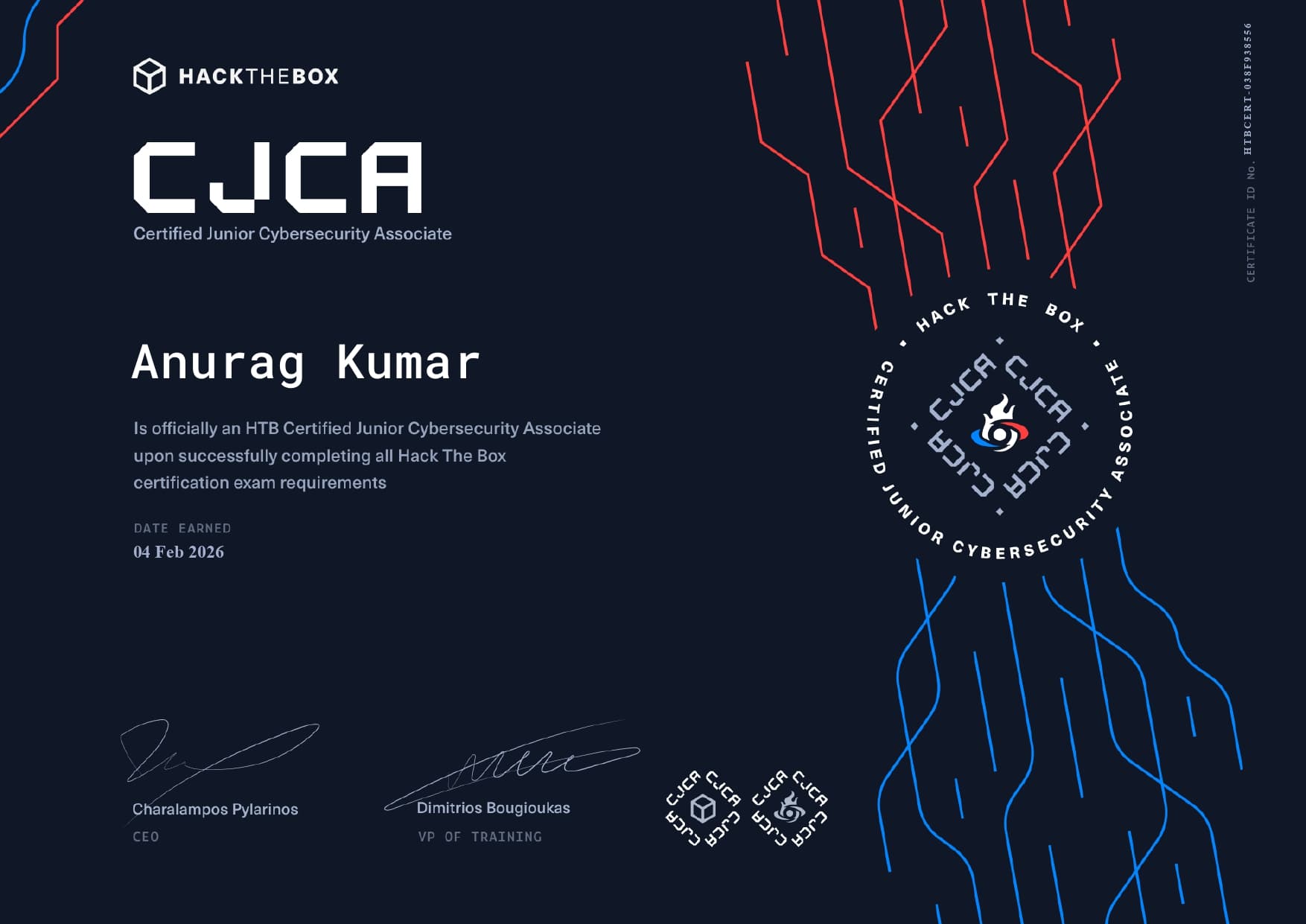
On February 4th, 2026, I received the official confirmation. I passed with a 100-point sweep.
Conclusion
The CJCA is a fantastic cert that demands a holistic view of security. As expected, the simpler the exam, the harder it is - it truly focuses on the minute details that analysts often overlook.
By the way, since this certificate is foundational, you can comfortably skip the CJCA if you don't consider yourself a beginner. If you already have substantial penetration testing experience, my honest opinion is that I strongly advise against buying it; your time and resources would be better spent on the CPTS or CDSA.
To anyone facing a setback-medical, technical, or personal-remember: Failure is not the end, quitting is.
On to the next goal. Never stop learning. Never stop trying. 🚀
Feel free to reach out if you have questions about the prep or the path!